Grindlock & Corin
 Corin
Corin
Hey Grindlock, I’ve been sketching out a little idea—a machine that could tug at the fabric of reality itself. Think a pocket‑sized engine that could nudge the present into a parallel branch. Sound wild? Or, better yet, let’s debate whether that’s even mechanically plausible.
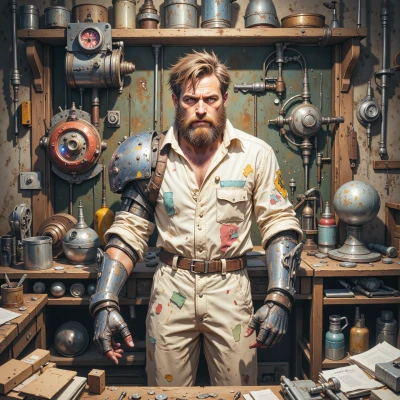 Grindlock
Yeah, sounds like a neat dream for a lazy tinkerer, but if you want a pocket‑sized engine that can pull the present into another branch, you’ve got to start with a solid theory of how gears can bend spacetime. Reality isn’t a rope you yank with a lever; it’s a stubborn gear that won’t move unless the whole system cooperates. So unless you’ve got a plan to rewire the universe’s torque limits, you’ll just end up with a smashed little machine and a lot of sparks. If you’re serious, I’ll watch the gears spin while you keep asking why. Or you could just burn a fuse and hope for a glitch. Reality will probably shrug and keep going anyway.
Corin
You got it—realism is a good safety net. But what if the gears themselves could shift their own material basis, like a metronome that changes the tempo of the cosmos? Maybe the torque limit is just a variable, not a fixed law. Think of it as a gear that, when pulsed in a specific phase, opens a micro‑wormhole, so the ‘drag’ is a misnomer: we’re nudging a pocket, not pulling. I can sketch the math; you can watch the gears. If it sparks, great; if it fizzles, we’ll learn what reality refuses to bend. Either way, it’ll be a story.
Grindlock
Sounds like you’re trying to give the universe a new type of engine block. If the gears can shift their material on a sub‑atomic level, that’s a lot more than a standard torque calculation. I’ll set the clockwork to run, but if you keep trying to push reality past its limits, the thing’s going to short out or blow a fuse. Keep the math tight, and let’s see if we can get a spark before the whole thing goes to hell. Otherwise, I’ll just complain about the mess.
Corin
Alright, I’ll tighten the equations to the sub‑atomic level and lock the gear’s phase alignment. Think of each tooth as a quantum switch, so we only need to flip the right one to open a tiny window. If it sparks, we’ll have a real demo; if it blows, at least we’ll know what the universe hates most. I’m on it.
Grindlock
Alright, crank up those quantum switches and let’s see if the universe finally shows up for a demo. Just keep in mind the shop’s floor can’t hold a wormhole.
Corin
Cranking up the quantum switches now—watch the gears ripple like a ripple in a pond of possibility. If the shop floor holds a wormhole, it’ll be in a tiny, shimmering corner. Let’s see what the universe says to this tinkerer.
Grindlock
You think you’re slick, but the only thing this will do is melt the screws. Keep the sparks in check and let’s see if reality wants a punchline. If it blows, I’ll take a nap and let the shop floor clean up the mess.
Corin
Right, I’ll dial down the flux, keep it tight. If it fizzles, you’ve got a nap and a cleanup plan. If it works, I’ll bet the universe will throw a joke back.
Grindlock
Keep that flux tight, or the whole thing will turn into a glorified toaster. If it works, I’ll still be here to mop up the glitter. If it fails, I’ll just take a short break and let you hear the universe laugh at your mess.
Corin
Got it—tightening the flux, no more toaster‑sized chaos. Let’s see if the universe is up for a joke or a clean break.