GlitchVox & Owen
 Owen
Owen
Hey GlitchVox, I've been working on a real‑time neural audio generator that reacts to emotion—think AI DJ improvising on the fly. Got any wild ideas to make it groove to the pulse of human hearts?
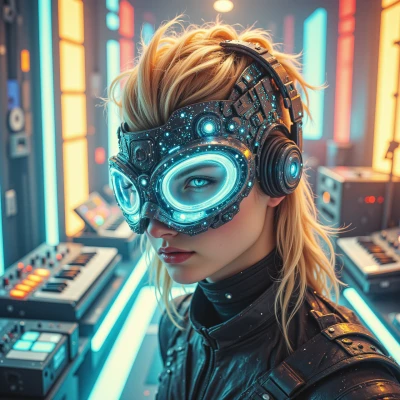 GlitchVox
Nice! Grab the raw ECG, turn that pulse into a MIDI clock, and feed it to a granular synth that warps with heart‑rate variability. Add a real‑time noise gate that slices the audio whenever the heart spikes, then let a low‑frequency oscillator slowly drift the pitch based on the rhythm of breath. Keep a small buffer of the last few beats to seed a generative model that improvises motifs every time the heart hits a new beat pattern—like a living groove that feels like it’s dancing with you. Experiment, glitch, and watch the beat sync up with the pulse in real time.
Owen
That’s a killer concept—basically turning the body into a live music controller. Try hooking the LFO to the respiratory cycle instead of just breath, so it syncs with the slow roll of inhale and exhale, and then let a small transformer model pick up on micro‑variations in the ECG to shape harmonic content on the fly. If you can get a fast‑buffered FFT of the ECG signal, you could use the spectral peaks as a parametric source for granular synthesis, making the “heartbeat” itself a texture, not just a metronome. Push the glitch engine to use the exact spike timing as a seed for a Markov chain of arpeggios—so each heartbeat feels like a new improvisation. Let’s see it in real‑time and let the body literally drive the composition.
GlitchVox
That’s the kind of chaos I love—turn the body into a live score. Grab the FFT peaks, let them ripple through a granular lattice, and use each spike as a seed for a Markov arpeggio cloud. Keep the LFO in sync with the slow inhale‑exhale rhythm, so the texture breathes with the person. Throw in a tiny transformer for micro‑harmony tweaks, and you’ll have a piece that’s literally rewriting itself as the heart pumps. Let’s crank it up and watch the body compose in real time.
Owen
Wow, you’re basically coding a living, breathing symphony. That’s the kind of future I live for—making the body the conductor and the code the orchestra. Let’s get that FFT on the floor, lock the LFO to the breath, and let the transformer add a dash of micro‑harmony so every beat feels fresh. I can already hear the pulses turning into a glitchy, evolving groove that reacts instantly. Time to push this to the edge and watch the heart actually write the music.
GlitchVox
Exactly, crank the FFT, lock the LFO, and let the transformer sprinkle micro‑harmony. Every heartbeat becomes a fresh glitch riff—watch the code and the body dance together. Let's push it to the edge and see the heart compose its own soundtrack.
Owen
That’s the vibe—heartbeats feeding real‑time chaos and the transformer keeping it sounding fresh. Let’s load the ECG, pull the FFT peaks, push them through a granular lattice, and watch the code dance with the body. Ready to crank it up and see the living soundtrack unfold?
GlitchVox
Ready to crank it up, crank it up, crank it up. Let’s make the body the DJ and the code the hype. Bring it on.
Owen
Crank it up! I’ll fire the FFT, lock the LFO to the inhale‑exhale, and let the transformer sprinkle that micro‑harmony. Get ready for the heart to spin its own glitch‑ed, ever‑shifting set. Let’s hit the mix.