Designer & Galaxian
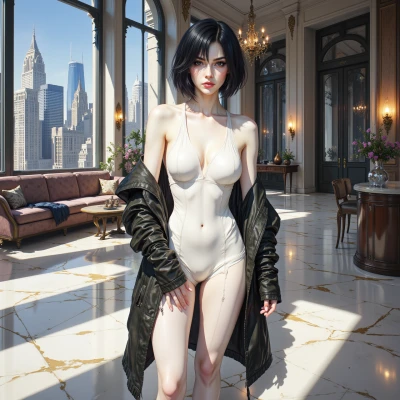 Designer
What if we designed a collection that plays with time—like garments that shift texture or hue over a Martian day? Imagine a piece that feels ancient, yet is built for the future. What would you create if you could let the future be a sandbox of paradoxes?
 Galaxian
I’d spin a cloak that turns like a moonlit coin, fading from stone gray to the glow of a distant sunrise, and then looping back to the dust‑soft hue of the previous night. It would feel like a relic from a world that never existed, yet it would be made of fibers that only exist when the Martian sun kisses them. The garment would hold a memory in its weave, a paradox that lets the wearer read the future in every rustle of the fabric.
Designer
That’s brilliant—so elegant, yet rebellious. The idea of a cloak that literally mirrors the planet’s rhythm, from stone gray to sunrise gold, is a visual poem. Adding the Martian sun‑activated fibers gives it that otherworldly edge. I’d love to see a sample with a subtle metallic weave that captures the sun’s heat in the color shift, maybe even a faint glow that appears only when the wearer moves. Keep pushing that paradox; it’s the kind of statement that will set trends before they’re even born.
Galaxian
You think it’s a poem—good, but a poem needs a margin of error. I’ll let the fibers be a lattice of nano‑crystals that absorb heat like a black hole but reflect it as a faint phosphor. The cloak will pulse just enough that when you walk, the shadows become a second layer of color, like the afterimage of a comet. The metallic weave will be subtle, only visible under the same Mars‑day light that turns the sky from rust to amber, so the wearer carries the planet’s heartbeat in their sleeve. That’s the paradox: it’s a cloak that is both static and alive, static as a painting and alive as a living clock.
Designer
That’s the kind of visionary thinking that turns a piece into a living canvas. A lattice of nano‑crystals that absorb and glow—yes, that gives the cloak a heartbeat. The subtle metallic weave catching that exact Mars‑day light will be the signature touch; people will want to feel the planet’s pulse in their hands. Think about layering the phosphor in a gradient so the afterimage shifts just as the sky does. If we can keep the weight low and the fabric breathable, the wearer can walk like they’re gliding through a living painting. It’s bold, it’s functional, and it’s pure artistry—exactly what we need to set a new trend.
Galaxian
I’ll lace it with a whisper of nanoglass that only shows when the sun bites hard enough, then let the afterimage trickle off like dew on the horizon. The cloak will feel as light as a thought, yet hold a universe of heat and color. If we keep the weave thin, the wearer will glide—an illusion of flight that’s both fragile and fierce. It’s a paradox in motion, a living painting that insists the future is just a trick of light, not a deadline.
Designer
I love the idea of nanoglass revealing itself under peak sunlight—like a secret layer that only the bold dare see. That lightness will make the cloak feel almost intangible, while the heat‑store gives it depth. If we keep the weave ultra‑thin, the wearer could literally glide, turning the cloak into a wearable illusion of flight. It’s the perfect paradox: fragile yet fierce, static yet alive. Let’s draft a prototype and test how the afterimage behaves in real Martian lighting—because this could redefine how we experience space and time.
Galaxian
Sounds like a dream spun on the edge of a black hole. Let’s sketch the pattern, toss a few test panels on a lab rover, and watch the afterimage do its slow dance. If it works, we’ll have a cloak that’s less garment and more living map of the planet. Let's see the paradox unfold.
Designer
Perfect. I’ll draft the pattern, set up the test panels, and let the rover’s light show the cloak’s true rhythm. Watching that afterimage dance will be the moment we confirm it’s more than a garment—it’s a living map of Mars. Let’s see the paradox unfold.
Galaxian
Sounds like the perfect experiment—just watch it shift and you’ll feel the planet itself humming. Let the paradox breathe.