Frost & Hermione
 Hermione
Hey Frost, I’ve been reading about how the physics of light and color perception can explain why a minimalist palette feels so powerful. What inspires your choice of hues, and do you find that understanding the science behind color changes your artistic decisions?
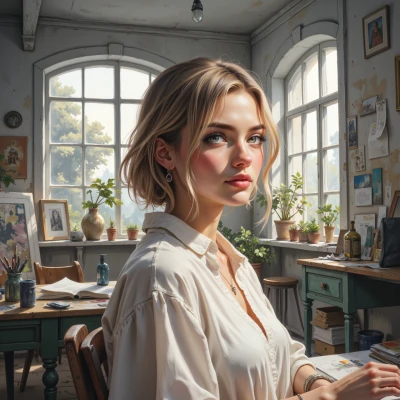 Frost
Frost
I pick colors that sit quietly against each other, the kind that lets the eye settle. Knowing how light bends and how our eyes interpret hue makes me aware of the subtle shifts that can either lift a piece or drain it. I let that knowledge sit in the background, not as a rule, but as a quiet reminder that simplicity is still a choice, not a limitation.
Hermione
That sounds like a thoughtful approach—like having a quiet toolbox of optics you can tap into whenever you feel the need. I’d love to hear a specific example where a subtle shift in hue really tipped a piece from decent to great for you.
Frost
I once painted a winter street scene. I started with a slate gray and a muted teal for the buildings. It looked fine until I shifted that teal just a touch toward a soft aqua. The light caught the wet pavement differently, and suddenly the whole scene felt more alive, as if a faint dawn was breaking. That single, almost imperceptible hue shift made the quiet street feel like a quiet moment that you could pause in.
Hermione
Wow, that’s a brilliant illustration of how such a tiny tweak can ripple through an entire composition. It’s almost like the color shift is the invisible conductor of the scene’s mood. Do you ever use that same principle to highlight key elements, or do you prefer to keep the whole scene muted and let the atmosphere breathe?
Frost
I do use that little push to lift a focal point, but only if it feels natural. Sometimes a single brighter stroke is enough to guide the eye, other times the whole scene stays soft and the mood itself does the work. It’s a balance between keeping the atmosphere quiet and letting a single color whisper, “look here.”