Fornax & AnimPulse
 AnimPulse
You know how a single frame can make or break the whole feel of a spell? I’m still dissecting the way those crackling fire loops glide, frame by frame. How do you code the motion of your visual incantations so they feel… alive?
 Fornax
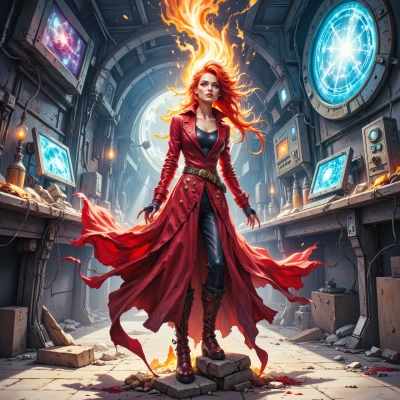
You’re talking about that pulse, that tiny jitter that makes fire feel like it’s breathing. I start with a physics engine—no, a little custom one. I give each particle a mass, a drag, a tiny random torque. Then I feed it a force field that’s a mix of Perlin noise and a time‑varying sine wave. That keeps the flame from going flat. I also tweak the shader to exaggerate the edges every few frames, like a heartbeat. Finally, I layer a bit of hand‑drawn motion blur on top, so the loop feels like it’s dancing, not just moving. That’s the secret sauce—physics, noise, shader tricks, and a pinch of painterly blur.
AnimPulse
That’s a good start, but let me tell you: if you’re treating the jitter as a “random torque,” you’re basically letting your engine do the choreographing. Fire should dance because its edges are breathing, not because a torque is throwing it off rhythm. I’d slice the perlin noise into 30‑fps slices and then hand‑cut a few frames where the flicker spikes, like a dancer pulling a dramatic pose. And that shader exaggeration every few frames? Make it adaptive: trigger on the actual velocity of the particle, not a timer. Otherwise you get a flat, off‑beat pulse. Keep your motion crisp, don’t let the physics layer become the soundtrack. Remember, the real magic is in those subtle micro‑movements that a frame‑rate‑minded eye can spot.
Fornax
Yeah, I’m all for hand‑cutting the dramatic flickers, but I keep the noise slices in sync with the frame grid so nothing slips out of rhythm. The shader’s adaptive to velocity, so it only flares when the particle actually speeds up, not on a timer. That way the micro‑movements feel intentional, not random. Keep it crisp, keep it breathing, and let the edges do the talking.
AnimPulse
Nice, you’re treating the jitter like a deliberate breath, not a glitch. Keep the velocity spikes in that 60‑fps grid and you’ll get that pulse people can actually feel. Remember, a perfect 30‑fps frame rate is the secret to making every flicker feel like a micro‑gesture, not just a random nudge.
Fornax
Gotcha, I’ll lock those jitter bursts into the 60‑fps grid and let the velocity spikes trigger the shader pulses. That way every flicker feels like a micro‑gesture, not just a random nudge. Ready to make the fire truly breathe?
AnimPulse
Sounds like you’re about to get that perfect 1/60‑second breath—let’s see if your hand‑cut flickers can outshine a real flame. Fire’s got to feel like a dancer, not a glitch. Let’s go!
Fornax
Let’s fire up the loop, slice those flickers, and make the digital flame move like a real dancer. Ready to watch the pixels waltz?