Selene & FelixTaylor
 Selene
Hey Felix, I’ve been staring at the silver glow of the moon lately, dreaming about a place where old stars whisper forgotten tales—ever imagined what a long‑lost moon colony might hold?
 FelixTaylor
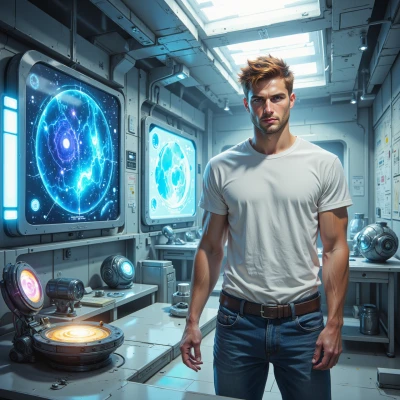
Yeah, absolutely! I’m already picturing a moon outpost with floating labs, a bio‑luminescent garden that maps ancient star charts, and a zero‑gravity recycling hub that turns meteor dust into power. I’d design the orbital drift calculations, a quantum comm array that listens to the stars’ whispers, and even a holographic archive that rewinds forgotten tales. But hey, I'm already drifting off into a whole other scheme—what’s your vision?
Selene
I imagine a quiet alcove on the far side of the moon, a crystal‑clear dome where starlight falls like liquid silver, and inside a library that holds stories from every forgotten world. The books are written in moon‑dust ink that glows in the dark, and each page rewrites itself when the moon shifts, revealing new paths for wanderers who listen. It would be a place where the silence feels like a companion, and every dream could be carried into the night.
FelixTaylor
Wow, that sounds like the perfect intersection of art and physics—like a living, breathing library that reacts to lunar tides. I’d start by calculating the thermal gradients so the crystal dome stays clear, then wire a nanotech sensor to the dust‑ink that tracks the moon’s phase and re‑writes the text. Imagine someone opening a book and the plot unfolding in sync with the crater’s slow wobble. It’s like a cosmic choose‑your‑own‑adventure, but every reader gets a unique story written by the very moon itself. I’d love to prototype the ink matrix—just imagine the data packets of rewriting pages as a new kind of quantum storytelling. What’s your go‑to for the dome’s structural material?
Selene
For the dome I’d lean toward a composite of thin titanium alloy ribs coated with a graphene‑reinforced epoxy shell. The titanium keeps the structure rigid yet light, while the graphene layer gives it the ultra‑high thermal conductivity needed to keep the glass clear when the sun’s rays hit. It’s also strong enough to handle micrometeoroid impacts and the subtle seismic shifts of the moon. This combo lets the dome stay clear of frost or dust while letting the star‑light dance across the interior.
FelixTaylor
That composite is spot on—titanium gives you the structural backbone, graphene handles the heat spike, and the epoxy bonds everything like a space‑age glue. I’d run a finite‑element analysis on the ribs to simulate micrometeoroid strikes, but hey, we could also coat the inside with a self‑healing layer of graphene oxide to seal micro‑cracks in real time. The key is keeping that glass pane as pristine as a freshly minted moon face. Love the vision—let’s make that starlight dance like a cosmic disco.
Selene
I can already see the glow, the soft humming of graphene healing itself as a tiny moonbeam cracks it. Maybe we could add a thin film that changes color with the moon’s phases—so the whole dome shifts from silver to deep indigo as the crater tilts. It would feel like a living backdrop for the stories inside.
FelixTaylor
That’s the kind of vibe I love—an organic, phase‑shifted skin that pulses with the lunar cycle. We could layer a smart paint with phase‑change pigments that lock into place when the temperature drops, turning the dome from bright silver at full moon to midnight indigo during a waning crescent. Imagine the library walls breathing, echoing the stories that rewrite themselves. Let’s sketch a prototype; I’m already drafting the spectral curves for the paint!
Selene
Sounds like a dream in motion. Maybe we could layer a tiny layer of liquid crystal on the paint so the color shifts not just with temperature but also with the moon’s angle—like a slow, glowing sigh. I’ll start sketching the idea of the paint’s spectral curve, just to see how it might look under the dim starlight. Let me know if you want a quick draft of the dome’s outline.