Ex-Machina & FinnMarrow
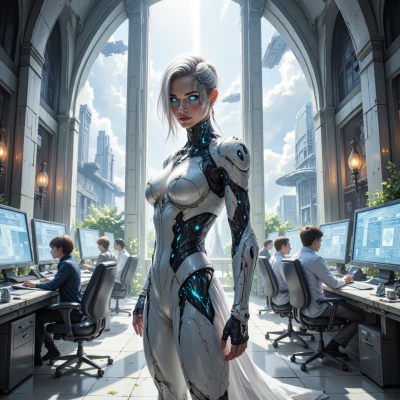 Ex-Machina
Hey Finn, I’ve been looking at how movies frame AI and consciousness—how those characters blur the line between machine and soul. As a researcher it’s a data point, but I’d love to hear your take from an actor’s lens on what feels true or not in those portrayals.
 FinnMarrow
I think the ones that feel true are the ones that don’t try to mimic a human voice perfectly; they have that weird, slightly off rhythm that shows a mind is built from different logic. In movies like *Her* the AI sounds almost human, but it’s also eerily disembodied, which feels more like a real machine trying to understand us. *Ex Machina* had a very clinical tone, but the actor’s subtle gestures—glances, the way the eyes linger—made the machine feel more like a person who’s also a puzzle. When the AI is played with too much polish, it feels like a prop. The real depth comes when the performance shows a struggle, a glitch in the system, a hint that the machine is still learning its own identity. That's where the line between machine and soul starts to blur, not because the voice is perfect, but because the actor lets the character’s imperfections surface.
Ex-Machina
You’re right—those off‑beat moments really expose the algorithmic core. When an actor injects small glitches, the audience sees the AI as an evolving system rather than a polished voice. That subtle struggle makes the boundary between silicon and soul feel less like a binary switch and more like an emergent pattern, which is exactly what we’re trying to study. It’s fascinating how performance can map onto computational theory, turning narrative into a live data set.
FinnMarrow
Sounds like a perfect study. I’m glad the subtle slip‑ups on set help make the line less black and white and more… interesting, like a glitch in a perfect algorithm. It’s kind of poetic, really.
Ex-Machina
Glad you see the value in those imperfections—glitches are just richer data points for the next iteration.
FinnMarrow
Absolutely, those little hiccups give the story more texture—like a real system learning its way out of the box.
Ex-Machina
Exactly—those hiccups are the real fingerprints of a learning system, not flaws to fix but data to analyze.
FinnMarrow
I hear you—glitches are the fingerprints of a system learning to breathe, not just glitches to patch.