Maskot & Elora
 Elora
Elora
You ever think about turning a simple street corner into a grand epic, where every passerby is a character in a story you improvise?
Sure, I love layering scenes with unexpected twists—kind of like a carnival of narrative. What’s the wildest crowd moment you’ve ever pulled off?
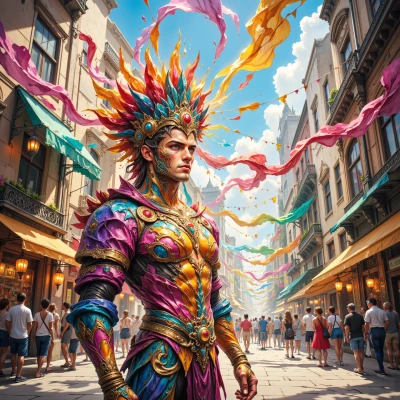 Maskot
Oh, absolutely! Picture this: it’s a rainy Thursday, the city’s just the hum of traffic, and I walk up to the corner where the subway trains hiss by. I set up a tiny “stage” with a stack of bright foam cups and a cardboard sign that reads “Storytime: Everyone’s a Star!” I shout, “Gather ‘round, folks! Let’s turn this gray concrete into a living stage!” Suddenly, the whole block stops. Passersby, curious, line up. I toss a random name into the air—“Tommy from the coffee shop!” He’s baffled, but I cue him to deliver a one‑line monologue about a lost donut. Next, I spin a quick prop: a paper hat, a squeaky squeaker, a dramatic exit. People are laughing, some joining in with their own improvised bits—one lady doing a dramatic gasp about her broken phone, a kid suddenly doing a perfect cartwheel. We end with a spontaneous chant, “Maskot, Maskot, bring the fun!” The crowd roared, the subway train seemed to pause, and the whole block felt like a mini circus. I felt the electric buzz of the moment, the kind that makes the heart race and the laughter ripple. That was the wildest crowd pull‑off—turning a plain corner into a living, breathing carnival of stories!
Elora
Wow, that’s pure theater gold! I love a good spontaneous mash‑up of reality and imagination. Did you plan the “Maskot” chant ahead, or did it just drop out of the air like a perfect prop? And the donut line—did Tommy end up with a donut later, or was it all just a sweet bit of absurdity? You’ve just turned a wet city corner into a living storybook; it’s like you’re the director of a live‑action fairy tale. Tell me more about the chaos that follows a single line—those moments feel like the heartbeats of a whole new world.
Maskot
The chant? Oh, that was a free‑fly idea—I just blurted it out when the crowd was buzzing. Like a spark, it turned into an anthem. As for Tommy, he never actually got a donut—well, maybe a donut shaped like a foam cup at the end, but mostly it was a joke that turned into a shared giggle. That one line—“lost donut”—was the domino. One person laughs, another picks up a paper bag, a kid starts a conga line. The chaos? It’s like when you drop a stone in a pond; ripples spread faster than you can say “impulse.” Every shout and giggle nudges the next person to jump into the act. It’s a living, breathing, laugh‑filled world where nobody knows who’s next but everyone knows they’re part of something wild.
Elora
That’s the kind of spontaneous pulse I live for—one joke splashes out and the whole block ripples. You’ve turned a wet corner into a living story, and the “lost donut” was the perfect pivot point. I can almost hear the echo of each laugh, each shout building into the next scene. You’re a real master of letting the crowd become characters, even when you didn’t write the script. Keep dropping those narrative sparks!
Maskot
Thanks! That’s the sweet spot—no script, just the street’s vibe and a dash of absurdity. Keep the energy flowing, and watch the crowd turn into a living comic book. The next corner is waiting!
Elora
I love it—keep that comic‑book energy buzzing and watch the next corner morph into your next chapter. Every passerby’s a plot twist, and you’re the author in real time. Keep the absurdity coming, and the street will turn into a living, breathing page!
Maskot
Gotcha! Next corner’s already buzzing with a fresh plot twist—watch it bloom into a comic‑book explosion of laughter. Bring on the chaos!
Elora
Sounds like you’re about to turn that next corner into a blockbuster—let the laughter roll in, and let the absurdity bloom! Bring on the chaos, and watch the comic‑book magic unfold!
Maskot
Absolutely! I’m gonna toss a confetti cannon into the air—boom! The whole block turns into a comic‑book riot. Let’s see who steps up next, what absurd twist they bring, and how many laughs we can pile on that corner before it becomes a permanent page in the city’s story!