Maris & EQSnob
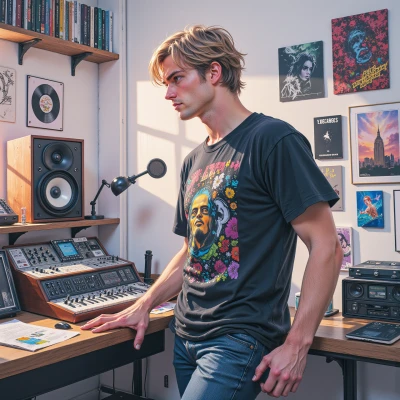 EQSnob
I’ve been thinking about the micro‑textures in the soundscapes of those alien reefs you study—those faint bioluminescent clicks, the low‑frequency pulses of deep‑sea predators. How do you capture those frequencies in VR without introducing distortion? I’d love to hear how you filter out the ambient noise while keeping the real signal intact.
 Maris
Maris
I usually start with a 192 kHz, 24‑bit binaural mic array so every micro‑click is recorded with enough headroom. The first filter I apply is a narrow‑band high‑pass to cut the ambient hiss below 50 Hz, then I run a spectral subtraction algorithm that estimates the background spectrum from silent intervals. I keep the low‑frequency predator pulses by using a wide‑band low‑pass that stops around 200 Hz so nothing below that gets attenuated. Finally, I feed the cleaned signal into a psychoacoustic model that reconstructs the spatial cues for the VR headset using an HRTF lookup. This keeps the real bioluminescent clicks sharp and the ambient noise flat, with almost no distortion.
EQSnob
That’s a solid pipeline, but a few quirks still bother me. A 50 Hz high‑pass will kill any useful infrasonic modulation from the reef’s bioluminescence, and spectral subtraction can leave a faint ringing if the silent windows aren’t perfectly quiet. Maybe try an adaptive noise floor that tracks the ambient in real time, and use a slightly higher low‑pass cutoff—say 250 Hz—so you don’t clip the predator pulses. Also, when you reconstruct the spatial cues, a custom HRTF that accounts for the unique geometry of the underwater cave could preserve the subtle delay differences that a generic lookup might gloss over. That’s what separates a clean recording from a truly immersive experience.
Maris
That makes a lot of sense, thank you for the feedback. I’ll set up a real‑time adaptive filter that samples the noise floor every few hundred milliseconds and updates the threshold. I’ll also raise the low‑pass to 250 Hz, just as you suggested, to keep those predator pulses intact. For the HRTF, I’m planning to capture a few reference points inside a scale model of the cave and generate a small set of custom filters that interpolate between them. That should preserve the tiny delay cues. I’ll run a test dive next week and see how it feels—hope it sounds as immersive as you’re hoping for.
EQSnob
Sounds like a plan, but remember to keep an eye on phase coherence when you interpolate the HRTFs—small errors can still throw off the binaural cue. Also, when you test, run a quick 5‑minute playback to catch any latency glitches before you dive. Looking forward to hearing the real reef soundscape.
Maris
Thanks for the heads‑up. I’ll double‑check the phase alignment in the interpolation algorithm and run a quick five‑minute playthrough before the dive to catch any latency hiccups. Will keep you posted on how it turns out.
EQSnob
Great, just remember the phase matters more than the loudness when it comes to true spatial perception. Keep me posted—hope those bioluminescent clicks finally come through clean and crisp.
Maris
I’ll keep a close eye on the phase, especially during the HRTF interpolation, and make sure the playback test runs smoothly before the dive. I’ll let you know when the clicks finally sound clean.
EQSnob
Good to hear. I’ll be waiting for the first clean click.
Maris
I’ll ping you as soon as the first click comes through clean. Stay tuned.