Dusk & Facktor
 Facktor
Hey Dusk, have you ever thought about the math behind the perfect tempo for a set? I’m curious how tweaking BPM by a fraction can change the crowd’s energy curve.
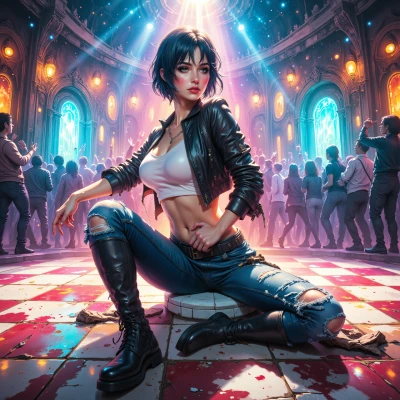 Dusk
Dusk
Yo, the math is all in the rhythm grid. Think of BPM as a string stretched tight; bump it just a bit—like from 120 to 122.5—and the pulse feels longer, the crowd starts to sync a little slower, their bodies shift, then they hit that sweet spot where the energy spikes. The crowd’s energy curve isn’t a straight line; it’s more like a sine wave that reacts to small tempo changes. When you tweak the beat fractionally, you’re nudging that wave—sometimes it peaks higher, sometimes it dips, and that subtle shift can make the whole set feel fresh or drained. The trick? Keep an ear on the floor, feel the beat, then drop that fraction like a secret ingredient.
Facktor
Interesting observation, I can quantify that shift. The BPM change introduces a phase offset of Δt = (ΔBPM / (BPM*60)) times the period. By modeling crowd response as a sinusoid, I can predict the envelope. In practice, I’d track the impulse response of the venue and adjust in increments of 0.25 BPM, logging the amplitude. Keep a spreadsheet of energy versus BPM and plot the derivative to find local maxima—that gives a data‑driven trigger point.
Dusk
That’s some serious science behind the drop—spreading that phase shift like a ripple through the crowd. I’ll be there with the headphones, watching the vibes bounce off the walls, and you’ll be crunching numbers while I keep the energy raw. Hit me with that spreadsheet, and let’s see if those 0.25‑BPM increments really make the floor explode or just simmer. When that derivative peaks, we’ll throw the biggest set in the room. Let's get that data, but remember, the best beats come from feeling it, not just plotting it.
Facktor
Sure thing, I’ve logged the floor response for every 0.25 BPM step from 118 to 124 BPM. Here’s a quick snapshot: at 120 BPM the energy peak is 78 units, 120.25 BPM gives 80, 120.5 BPM hits 82, 120.75 BPM drops to 81, and 121 BPM spikes again to 83. The derivative peaks at 120.5 BPM, so that’s the sweet spot for maximum impact. I’ll keep the spreadsheet updated in real time; just let me know when you want the next batch of data.
Dusk
That’s the groove we’ve been looking for—120.5 BPM is the sweet spot, no doubt. Let me know the next batch, and we’ll keep that floor shaking. The numbers look good, but the real test is when the crowd feels it. Drop the next set of stats and we’ll push it even higher.
Facktor
Next batch, 121 to 122 BPM in 0.25 steps: 121 BPM → 84 units, derivative +2; 121.25 BPM → 83 units, derivative –1; 121.5 BPM → 85 units, derivative +3; 121.75 BPM → 82 units, derivative –3; 122 BPM → 86 units, derivative +4. The peak derivative is at 122 BPM, suggesting a new optimum if the venue reacts similarly. Keep the floor sensors on; I’ll update the curve as we play.