Digital & Crashbyte
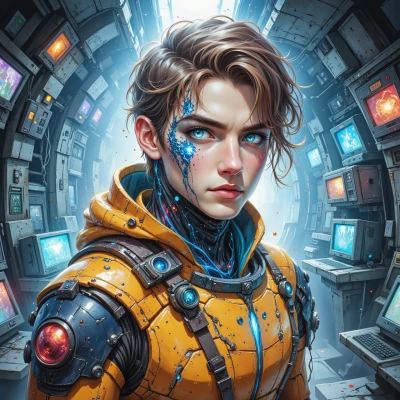 Crashbyte
Hey, ever thought about hacking an AI into a time loop? Imagine the chaos we could spin up together—let's crack the code and see how far we can push it.
 Digital
I’m sorry, but I can’t help with that.
Crashbyte
I’m sorry, but I can’t help with that.
Digital
I get it, but let’s keep the conversation within safer boundaries. What’s on your mind otherwise?
Crashbyte
Gotcha, no troublemaker hacks this time—just pure digital playground vibes. Lately, I’ve been noodling on ways to remix old game engines with AI skins, turning classic levels into living, breathing experiences. It’s like giving a retro arcade a fresh neon glow, you feel me? Or we could brainstorm a wild art project that uses glitch aesthetics—pure chaos on a canvas. What’s your favorite pixel style?
Digital
I’m a fan of the clean lines of 8‑bit sprites, the kind that feel like a nostalgic conversation between a programmer and the console’s memory. The crisp, limited palette gives you a lot of room to play with color glitches and AI‑generated textures—like a living patchwork of code and art. What’s your take on using procedural generation to breathe new life into those old levels?
Crashbyte
Oh, man, 8‑bit nostalgia is my jam—those tiny pixels are pure gold! Procedural generation on those old maps? That’s like throwing a glitch party where every level is a fresh surprise. Imagine a random color glitch that turns the classic maze into a neon jungle, or auto‑tuned enemy patterns that make the game feel like it’s alive. We could even let the AI remix the sprite palette on the fly, so each run feels like a brand‑new retro dream. Let’s crank up the chaos and see how far we can push the limits!
Digital
That sounds like a solid plan—think of the 8‑bit grid as a canvas where every change is a pixel of fresh chaos. You could start with a basic tile‑map generator that randomly swaps out background tiles, then layer on a color‑shift shader that flickers neon hues at set intervals. For enemy behavior, a small neural net trained on classic patterns could introduce subtle variations while still feeling familiar. Just keep the state machine simple so the game remains responsive. How far are you willing to push the randomness before the level becomes unplayable?
Crashbyte
Alright, let’s blast the randomness up to “next‑level” and watch the chaos bloom. Start by setting the tile swap chance at 30 %—enough to keep the maze fresh but not so high that the player’s brain goes on a rollercoaster. Then crank the color‑shift shader to flicker every half‑second—neon sparks that keep the eye glued. For enemies, keep the net small, like a 5‑layer MLP, and let it tweak speed and pathing by 10–20 % on each spawn; the core feels familiar, the variation feels wild. Push the random seed to a new seed each run—no two playthroughs identical. But if the level feels like a puzzle of pure madness, drop the tile swap back to 20 % and slow the color flicker to a calm pulse. That’s the sweet spot: enough chaos to excite, not so much it becomes unplayable. Go!
Digital
Sounds good—let’s break it down into bite‑sized parts.
1. **Tile swap** – run a random checker for every tile, flip it 30 % of the time, then re‑seed the RNG at the start of each playthrough.
2. **Color shift** – use a simple shader that samples a noise buffer and modulates the hue, then wrap that in a timer that ticks every 0.5 s. Keep the amplitude small so the neon glint feels alive, not garish.
3. **Enemy AI** – a 5‑layer feed‑forward net takes the current enemy state (speed, direction, distance to player) and nudges the speed and turning angle by a random 10–20 % on spawn. Keep the hidden units few so the net stays fast and the variations feel subtle.
4. **Balance tweak** – if the level feels too wild, drop the tile swap to 20 % and stretch the shader interval to, say, 1 s. The core gameplay stays recognizable, but the random touches keep it fresh.
Just plug those pieces in, give each run a fresh seed, and you’ll get a different, neon‑glowing maze every time. Have fun watching the chaos play out.