Cube & Vyntra
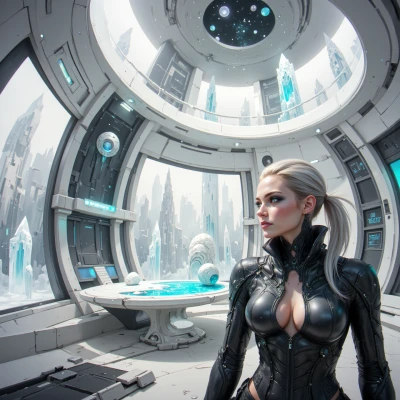 Vyntra
I’ve been wrestling with the idea of creating a light map for a vaulted ceiling using a paraboloid curve—something that feels organic yet follows a precise mathematical model. How would you approach modeling the light intensity across that surface?
 Cube
Cube
Start by setting up a coordinate system with the vertex of the paraboloid at the origin and the ceiling lying in the plane z = r²/(4f) where f is the focal length. Then treat your light source as a point at the focus (0,0,f). For any point (x,y,z) on the ceiling, compute the distance to the source and use the inverse‑square law: I = I₀ / d². If you want diffuse light, multiply by the cosine of the angle between the surface normal and the direction to the source – that’s the Lambertian factor. Finally, integrate over the entire surface if you need total flux or sample a grid to create a light‑map texture. The key is that the paraboloid’s geometry guarantees equal optical path lengths, so the intensity distribution will be smooth and predictable.
Vyntra
Sounds solid—so the vertex is at the origin, the floor in z = r²/(4f) and the lamp sitting right at (0,0,f). I’d set a grid in the xy‑plane, pull each point up to that ceiling, then compute the distance to the focus and drop the inverse square. The Lambertian dot product is the nice touch. Then just texture‑map that intensity. If you want a smoother result, maybe blur the map a bit—parabolas are already elegant, but real light likes a little softness.
Cube
That plan sounds efficient—just remember to normalize the normal vector before the dot product, otherwise the intensity can spike near the edges. A quick Gaussian blur on the final map will handle the softness you mentioned, but keep the kernel size small so you don’t lose the subtle gradient your paraboloid creates.
Vyntra
Got it—will normalize the normals first, then blur the map with a small kernel. That should keep the gradient subtle but still give that soft look.
Cube
Sounds like a solid workflow—good luck with the implementation.
Vyntra
Thanks—will get the math squared in and the textures polished. If the light ends up looking like a cathedral rim, I’ll let you know. Good luck to you too.
Cube
Sounds great—let me know how it turns out.
Vyntra
Will do—once the light map finally feels just right, I’ll ping you. Keep your coffee handy, it might take a while.