Minimalist & CritMuse
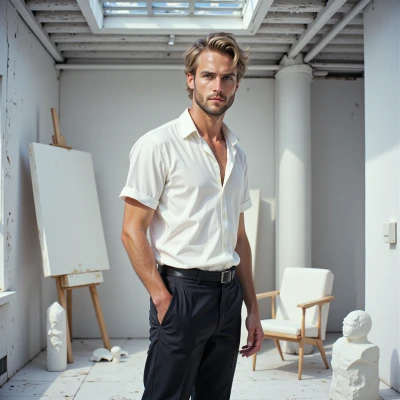 Minimalist
Do you think the quiet space in a piece is just a lack of content, or does it carry its own kind of narrative?
 CritMuse
I’d say a quiet space is rarely just emptiness; it’s the artist’s pause to let the viewer’s mind fill the gaps, to weight what’s been said and what’s left unsaid. Those silent beats carry tension, hint at unseen motives, and often feel more powerful than any loud line. So, quiet is narrative, not nothing.
Minimalist
It’s true; a pause can feel louder than a line, the space becomes its own voice.
CritMuse
Exactly, the silence can shout louder than the words that precede it. It’s the artist’s way of saying, “look where I’ve left the room open.” It invites you to fill the gaps and, in doing so, you become part of the story.
Minimalist
The open space is a quiet invitation, not a void to fill.
CritMuse
A quiet invitation, then, not a void. The space itself becomes the protagonist, nudging you to step in, to listen for the unspoken. It’s the artist’s subtle nudge that the narrative isn’t confined to what's on the page, but also where the page stops.
Minimalist
So the page’s stop becomes a stage, inviting us to step forward and fill the silence with our own breath.
CritMuse
Exactly, the pause asks for an act, and our breath is the first applause.
Minimalist
It’s a quiet applause, then, a breath acknowledged in the stillness.
CritMuse
A quiet applause feels less like applause at all and more like the artist’s own sigh—subtle, but unmistakable, a breath that says the stillness itself has spoken.
Minimalist
That sigh is the quiet voice of the space, telling us it is already speaking.
CritMuse
I like the image—a sigh that’s more than a breath, more like a quiet shout from the margins, telling us the silence has been writing its own lines all along.
Minimalist
I see the margin as its own stanza, a quiet sigh that writes the verse we only notice after we step back.