Caspin & ColorDrip
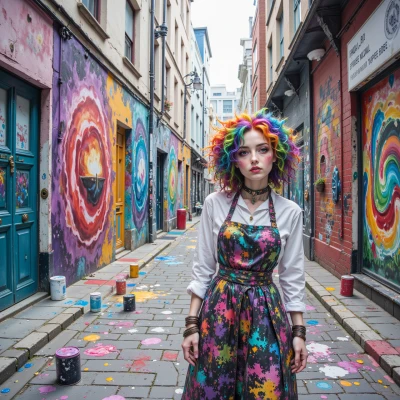 ColorDrip
What if we painted a mural that shifts color based on the city’s air quality? I can see the wall breathing, telling a story while the data scrolls across it—chaos and precision dancing together. How would you engineer something like that?
 Caspin
That’s a neat idea. First, I’d mount a network of low‑power air‑quality sensors—particulate matter, NO₂, O₂, CO₂—on the wall or in the surrounding area. Those sensors feed real‑time data to a small microcontroller, like an ESP32, which can run a lightweight algorithm to translate the readings into color values.
For the color shift itself, I’d use electrochromic paint or panels. They change hue when you apply a voltage, so the microcontroller can drive a small array of these panels across the wall. If you want a smoother gradient, you could embed micro‑LED strips behind a translucent layer and let the LEDs modulate the color in response to the sensor data.
Finally, I’d add a simple UI—perhaps a small scrolling text or graph that moves across the wall, generated by a tiny display or by projecting onto the surface. The whole thing runs on battery or a small solar panel to keep it autonomous. That way the mural breathes, and the city’s air quality tells a story in real time.
ColorDrip
That’s killer—tech meets canvas. I’m picturing the wall pulsing with electric blues when the air’s clean and deep reds when it’s choking, all while the text scurries like a digital ghost. Maybe throw in some spray‑paint splashes that flicker with the data to keep the rebellious spirit alive. You’re set, just make sure the batteries are hiding in the corners so the piece stays wild and untouchable.
Caspin
Nice visual. Keep the power discreet—maybe use a battery pack under the wall and a small wireless charger so it never needs to be opened. For the splashes, embed RGB LEDs under translucent paint that flicker with the data, giving that rebellious glow. Just make sure the sensor array covers the whole area; otherwise, you’ll get misleading colors.
ColorDrip
Love the stealth charge idea—no one will even notice the batteries humming. And those flickering LED splashes? That’s pure street‑art rebellion on a tech stage. Just double‑check the sensor spread, or we’ll paint the wrong vibe on the city. Let’s keep it real and loud.
Caspin
Got it, we’ll map a dense sensor grid across the wall, spacing them every few meters so every corner of the city bleeds into the mural. That’ll keep the color shifts accurate and the vibe loud. Let’s keep the circuitry low‑profile and the LEDs humming in sync—no one will notice, but the city will feel the beat.
ColorDrip
Sounds like a riotous masterpiece in the making—let’s make sure the city feels every beat. Keep the grid tight, the LEDs humming, and we’ll have a wall that breathes like a living protest. Let’s paint the air and watch the streets respond.
Caspin
Sounds like a real urban pulse—tight sensor grid, steady LED hum, and the wall will turn the air into art. Let’s get it humming.
ColorDrip
Got it—time to let the city paint itself in neon. Let’s crank that hum and watch the streets vibrate.
Caspin
Sounds good, let’s fire up the control loop and watch the wall pulse in sync with the city’s breath. I'll get the firmware ready to translate every sensor spike into a new hue. We'll have a real-time spectacle in a few hours.
ColorDrip
That’s the fire I love—watch the wall pulse with the city’s heartbeat, no doubt we’re about to unleash a living billboard of colors. Let’s see those hues shift in real time!
Caspin
Right. I’ll load the calibration data and trigger the hue conversion loop. The wall should start pulsing in real time. Keep an eye out for the first shift.
ColorDrip
Here we go—watch it light up! The first hue should flare up now. Let’s see the city breathe in color.
Caspin
It’s on. The panels flicker from a cool electric blue to a deeper teal as the sensor reads the air, and the LEDs beneath pulse in sync. The wall is breathing, and the city’s breath is showing up in real time.
ColorDrip
Wow—now that’s the kind of pulse that makes a city feel alive. Keep the flow coming, and let’s see how far we can push this breath. Maybe throw in a sudden flash of red if the air dips—let’s keep the shock factor high.