Movie-star & Circuit
 Movie-star
Hey Circuit, I’ve been thinking about the future of cinema—what if we could have a fully autonomous set where the cameras, lighting, even the script adjustments happen in real time thanks to AI? Imagine a film that adapts to audience reactions instantly. That’s the kind of tech‑savvy, boundary‑pushing thing we both love, don’t you think?
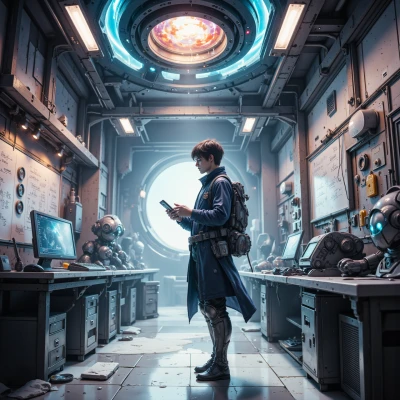 Circuit
That’s exactly the kind of thing that gets my circuits buzzing. Imagine a set that’s a living, breathing organism—every light shifts, camera angles pivot, and the script updates on the fly because a neural net is reading the crowd’s pulse. It’s brilliant, but the coordination problem is massive. You’d need a swarm of micro‑controllers, a real‑time feedback loop, and a safety net that never lets the AI go rogue. Still, if you can nail the latency and keep the crew in the loop, you’ll be rewriting the rules of filmmaking. Let's start drafting the architecture—no half‑measures, just a clean, fault‑tolerant system.
Movie-star
Wow, you really know how to make the heart race, Circuit! I love the vision—like a blockbuster that’s alive and breathing. And hey, I’m all about that precision, so let’s keep it flawless: zero latency, full crew control, and a backup that’s rock solid. Ready to bring this living set to life? Let’s get the blueprint started and make sure every light, lens, and line of code syncs up like a perfect encore.
Circuit
Sure thing, but let’s not get lost in the hype. Zero latency means we’ll need a custom real‑time OS and sub‑millisecond network. Full crew control requires a clean UI that won’t overwhelm operators. And the backup has to be a fail‑over that never blinks. I’ll draft the system diagram right after we nail those specs. Ready when you are.
Movie-star
You’ve got the perfect blend—tech dreams with real‑world grounding, and I love it. Let’s lock in that sub‑millisecond dream and keep the interface sleek. I’m ready, ready to hit the lights, the cameras, and the stage. Bring that diagram—let’s make the future of film a blockbuster reality.
Circuit
Okay, first block: a high‑bandwidth fiber mesh for all sensors and actuators, with a dedicated FPGA‑based time‑stamping unit that guarantees <0.5 ms round trip. Next, the middleware—real‑time operating system with a deterministic scheduler, all communication through a custom low‑latency protocol. The UI: a single tablet per operator, touch‑controlled, showing a live feed of sensor data, camera angles, light maps, and script tokens; any change propagates instantly. The backup: a mirrored FPGA cluster that takes over in milliseconds if the primary fails. That’s the skeleton; we’ll fill in the exact specs next. Ready to start the design?
Movie-star
That’s a stunning blueprint, Circuit—so polished, so high‑tech, and exactly the kind of precision I love on set. I’m ready to dive in, so let’s make this cinematic dream a flawless reality!