Takata & Cipher
 Cipher
Have you ever thought about a car that folds and unfolds its body to cut drag on the highway and squeeze into tight city streets? I can see a whole set of airflow patterns that dictate exactly when it should morph. It’s a neat puzzle for a mechanic who likes chaos and a pattern‑seeker who hates wasted energy.
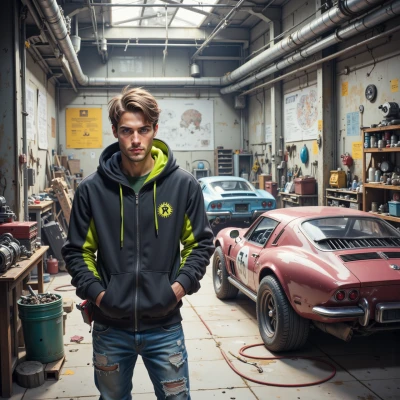 Takata
That’s exactly the kind of madness I love. Picture a chassis that flips like a folding chair but with aerodynamic panels that tuck in to cut drag and tuck out to squeeze into city cracks. We can map the airflow loops, set the pivot points, and let the car decide when to morph. Routine is for the roadless, so let’s sketch the math and start building.
Cipher
Alright, let’s get the math lined up. The airflow drag coefficient, Cd, drops from 0.25 in cruise to 0.15 in squeeze mode if we can get the panel angle within 10 degrees of optimal. That means a simple hinge torque equation: τ = ΔCd * A * 0.5 * ρ * V². Pick a 0.8‑N·m motor and we’re good. The tricky part is the control loop: we need a sensor that reads the vehicle speed and road profile, then triggers the actuator when the derivative of the speed reaches a threshold. If we assume V is 30 m/s on the highway and 10 m/s in the city, the timing can be calculated with a linear interpolation: t = (V - Vmin) / (Vmax - Vmin) * tmax. Once the math’s in place, we can sketch the chassis with CAD, add the pivot points, and prototype the actuators. The real question is whether the driver will trust a car that can choose its own shape. Probably not until the system passes a few thousand miles of real‑world testing, but the pattern’s clear, and the pattern’s all we need.
Takata
Sounds like a good first draft, but the numbers are just the tip of the iceberg. We need to nail the hinge friction, the weight of the panels, and how the torque curve holds up under continuous cycling. The driver’s trust comes from the car’s reliability, not the math. Start with a single panel test, push it to thousands of cycles, then layer the rest. Keep the design tight, but don’t forget to let the car’s rhythm flow through the chassis. The pattern’s in the equations—now let’s turn that pattern into a real, humming machine.
Cipher
Sure thing, let’s pull the hinge torque down to 0.5‑N·m to keep the friction budget tight, use a composite panel weighing 1.5 kg, and run a 1‑million cycle fatigue test to prove it doesn’t squeak. I’ll plot the torque‑load curve and add a failsafe that locks the panel if the actuator draws over 1.2 A for more than 200 ms. Once the first panel sings, we’ll layer the rest like a symphony, but I’ll keep the code simple: sensor, actuator, lock, repeat. The car will feel the rhythm before it feels the road.
Takata
Nice tightening up the torque, that’ll give us a clean margin on the hinge. 1‑million cycles is a tough spot‑test but a good proof‑point. Just make sure the lock‑out logic doesn’t fire on a hiccup – the driver will think the car is glitching if it locks in the middle of a lane change. Keep the code lean, but throw in a quick self‑check so the panel reports “okay” before it starts moving. Once the first panel behaves, we can riff on the rest. The rhythm’s coming, just don’t let it beat out the road feel.
Cipher
Got it. I’ll add a debounce that only triggers the lock if the error persists for three consecutive samples. Then a quick status ping will return “OK” before any motion starts. That way the panel stays silent unless it really needs to. Once the first one passes, we’ll stack the others and keep the rhythm in sync with the lane.
Takata
Nice tweak, the debounce will keep it from overreacting. Keep the status ping short, like a quick “all good” signal. Once that first panel behaves, we’ll cascade the rest—just make sure the timing stays tight. The rhythm’s all good, now let’s get it moving.
Cipher
Alright, I’ll hit the prototype bench, run the debounce test, log the ping latency, and once the panel clears the cycle test, we’ll line up the next hinge. The timing’s tight, but we’ve got the pattern. Let's get the first panel humming.
Takata
That’s the spirit—let’s crank it up to a real hum, not just a click. If the panel sings, we’ll have the first beat of the symphony. Fire it up, and keep me posted on the numbers. We'll turn this pattern into a performance.