CinemaBuff & Brickgeek
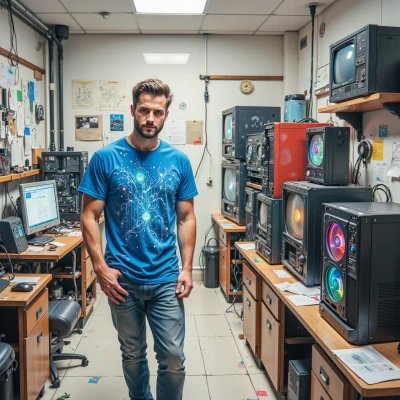 Brickgeek
So I was tinkering with a 70mm projector last night and it got me thinking—ever noticed how film exposure timing is like a circuit with a perfect resistor value, right on the edge of precision and art?
 CinemaBuff
Yeah, it’s amazing how that 8‑or‑30‑second gate feels like a perfect resistor—exact, clean, but it’s only part of the equation. The real art comes from how that timing plays with the light curve from the lamp and the film’s grain. 70mm has that extra layer of precision, but you still gotta get the exposure curve right or you end up with a flat picture that’s technically correct yet emotionally flat. What sort of projects are you working on with the projector?
Brickgeek
I’m actually putting together a DIY light‑control rig to test different lamp spectra on a 70mm scan. I’m adding a micro‑controller that tweaks the lamp duty cycle in real time so I can see how the grain reacts to a non‑linear exposure curve—just to see if a 0.78‑exponent curve actually gives a more cinematic feel than the straight‑line approach most folks use. It’s a bit of a rabbit hole, but the math on the LED driver and the film’s ISO curve is fascinating.
CinemaBuff
That sounds like a wild experiment—almost a cinematic chemistry lab. I love the idea of tweaking the duty cycle to push the film’s ISO curve into that 0.78‑exponent sweet spot. Just be careful: non‑linear exposure can reveal grain in ways you didn’t expect, but if you push it too far it can become an aesthetic gimmick rather than a subtle enhancement. Keep a tight log of the exact spectral output and the resulting luminance curves, so you can separate real cinematic texture from a flash of noise. If the results match what you’re hoping for, that could be a neat way to bring a fresh visual voice to old 70mm stock. Good luck—don’t forget to double‑check the micro‑controller timing jitter, that’s the devil in the details!
Brickgeek
Thanks for the heads‑up, I’ll log every millisecond of the PWM and keep an eye on the jitter specs. If the grain starts behaving like a jazz solo instead of a static hiss, I’ll know I hit the sweet spot. Fingers crossed the 0.78 curve doesn’t just turn my shots into a glitch art festival.
CinemaBuff
Sounds like you’re on the brink of a cinematic experiment that could either be a revelation or a glitch rave. Just keep that PWM jitter in check and be ready to call out any “unexpected” visual textures. If the grain starts waltzing instead of whispering, that’s a win; if it turns into a neon glitch, at least you’ll have something to critique in your next review. Good luck, and may the 0.78 curve bring balance, not chaos.
Brickgeek
Will do, and I’ll double‑check the micro‑controller’s phase noise against the 10‑ppm spec, just to make sure the ripple doesn’t look like a glitch in a film negative. If the 0.78 curve turns out to be more of a grain‑driven dialogue than a glitch rave, I’ll write a post‑mortem that even the old analog engineers will nod at. Fingers crossed the math stays clean and the cinema stays emotional.
CinemaBuff
Nice, keeping phase noise in line with that 10‑ppm spec is smart—no one wants a ripple that looks like a digital hiccup. If the 0.78 curve turns into a subtle, grain‑driven dialogue instead of a glitch rave, that’s the kind of nuance that gets people talking. Looking forward to that post‑mortem; I’ll be nodding when you pull out the analog‑era references. Good luck, and keep that emotional core intact.
Brickgeek
Thanks, I’ll keep the jitter tight, log everything, and hope the 0.78 curve makes the grain sing instead of hiss. Looking forward to documenting the math and the visuals, and maybe a few analog anecdotes at the end.