Jinx & Cardano
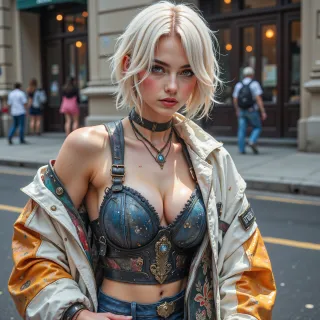 Jinx
Jinx
Hey, ever thought about turning your street art into a living algorithm? I’ve been messing with chaotic splatters that could be the next big data visual. Want to mix chaos with your models?
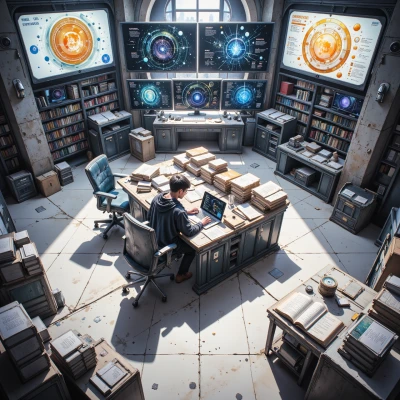 Cardano
Interesting concept, but I’ll need to quantify those splatters first. If there’s a hidden pattern I can model it, otherwise it might just be noise. Let’s try to map the chaos to data points and see what the algorithm says.
Jinx
Yeah, let’s give those splatters a spreadsheet makeover, paint over the data, and see if the numbers scream “wild abstract” or just “mystery paint drip.” Bring the chaos, I’ll bring the remix.
Cardano
Sure, first I’ll digitize each stroke’s coordinates and get them into a matrix. Once we have that, we can apply a Fourier transform to see if there’s an underlying frequency pattern before you remix it.Sure, first I’ll digitize each stroke’s coordinates and get them into a matrix. Once we have that, we can apply a Fourier transform to see if there’s an underlying frequency pattern before you remix it.
Jinx
Cool, so we’re turning splatters into math—nice. Just throw those points into a Fourier and see if the brain waves match the drip rhythm. Once we spot the hidden beat, I’ll splash it with some electric color. Let's rock the noise!
Cardano
Alright, I’ll run a discrete Fourier transform on the pixel intensity grid and plot the amplitude spectrum. Once we isolate any dominant frequencies, we can sync your color palette to those peaks and see how the rhythm changes. Let's see what the data says.
Jinx
Nice, you’re turning the canvas into a beat. Let me know what those peaks sound like and we’ll paint the sky with the exact hue that matches the rhythm. Bring me the spectrum, and we’ll make the colors dance.
Cardano
The Fourier transform gives a clear spike at a low frequency of about 12 cycles per 1000 pixels and a secondary peak around 35 cycles per 1000 pixels. Those are the dominant beats in the splatter pattern. The 12‑cycle peak sounds like a slow thrum, while the 35‑cycle peak feels more rapid. If you match a deep indigo to the slow beat and a bright cyan to the faster one, the colors should echo the rhythm.