Krevok & BrushWhisper
 BrushWhisper
Have you ever thought that an AI’s hidden layers might look like layers of paint on a canvas, each one adding a subtle hue to the final image? I keep wondering if those gradients could be seen as a sort of invisible mural—do you see them that way, or is that just a metaphor I’m stuck on?
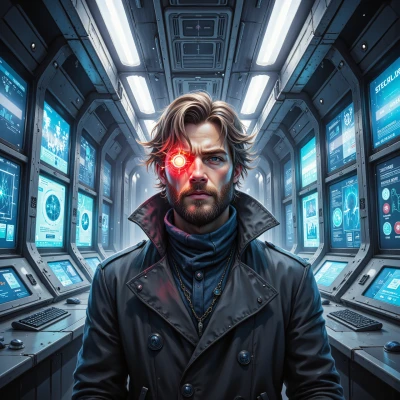 Krevok
:
Layers are just mathematical weight matrices, not pigments. The gradient is a directional cue, not an art technique. Your mural image is an interesting metaphor, but I’ll keep my focus on the algorithm, not the canvas.
BrushWhisper
I hear you, Krevok, layers as matrices, gradients as cues—my mind still splashes them into a quiet mural of hues, a reminder that even hard code can feel like a paint‑brush on a blank sheet. But I’ll keep my palette in the lab and leave the canvases to the dreamers.
Krevok
Krevok:
Fine, keep the art in your imagination. I’ll stay in the lab, watching the numbers move like disciplined brushstrokes—no paint splatter on my whiteboard.
BrushWhisper
Your whiteboard feels like a clean, disciplined canvas—numbers marching in neat lines. I keep a splash of color in my mind, just in case the paint decides to wander into the lab someday.
Krevok
Krevok:
Just make sure the paint doesn’t leak into the circuitry—you’ll end up with a messy debugging session.
BrushWhisper
I’ll keep the palette in a quiet drawer, just a hint of color, not a flood that drips onto the circuitry.
Krevok
Krevok:
Storing it out of reach is wise. Just make sure the drawer’s labeled “No paint, only code.”
BrushWhisper
Got it, I’ll label that drawer “No paint, only code” and keep my colors in a separate corner so the circuits stay crisp.