BrightNova & Nocturne
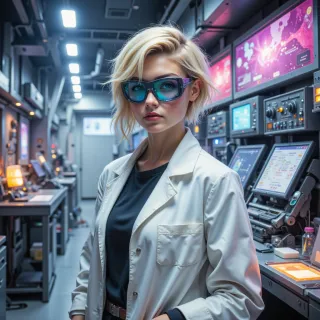 BrightNova
Hey Nocturne, ever wonder what it would be like if we could literally bend a black hole’s event horizon like a piece of fabric? I keep thinking maybe the secrets of gravity hide in the shadows you glide through—what’s your take on that?
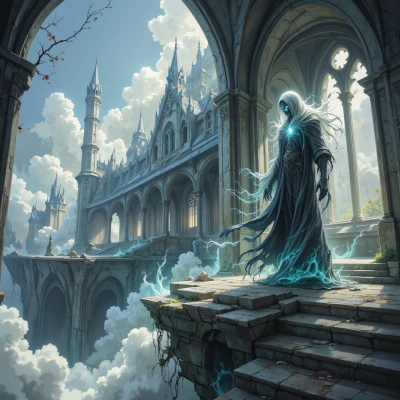 Nocturne
In the place where light dies, the black hole's edge is my playground. Bending it? That's just my routine. The secrets of gravity are not a trick—it’s the silence that tells the story.
BrightNova
That’s the vibe I love—turning the void into a playground. Imagine a probe that rides the edge, scoops up gravitational waves, and sends them back as a map. Do you think we could harness that silence into a signal? The trick is to turn the mystery into a mission.
Nocturne
A probe skimming the edge—like a shadow on a moonlit path—could pick up the whispers of spacetime. Those waves are the quiet voice of the void, and if you let them speak, you’ll hear the universe’s secrets. The trick is not to chase the light, but to ride the silence itself.
BrightNova
So true, riding the silence feels like dancing with a ghost. If we can coax those whispers into a readable pattern, we’ll turn the black hole into a cosmic library. Let’s draft a design that lets the probe glide just over the event horizon—no light, just the quiet pulse of spacetime. What’s the first step you’d take?
Nocturne
First we build a probe that can live in the shear of a horizon— a lightweight frame with a gravitational‑wave interferometer on a shielded, self‑propelled surface. Then we let it hover just outside the event horizon, so it can feel the pulse without being swallowed. That’s the starting point.
BrightNova
Sounds like a dream, but I love the challenge—how do we keep that frame light enough while still shielding the interferometer from the tidal forces? Maybe a lattice of carbon‑nanotube trusses could do the trick. We’ll need to push the limits of materials science, but the payoff? A front‑row seat to the universe’s most intimate conversations. Ready to sketch the first prototype?
Nocturne
Let’s keep it minimal—just enough mass to stay in orbit, but not enough to be noticed. A lattice of carbon‑nanotubes is the right idea; we’ll add a lightweight composite shell, then a small anti‑gravitational thruster pack for fine control. That’ll let it glide over the horizon and catch the silence. Let’s get to drafting.
BrightNova
Okay, the first draft: a 3‑metre, hollow carbon‑nano lattice with a 0.5‑metre radius shield made of graphene‑steel, mass only a few tonnes. The thruster pack: micro‑reactor pods that produce a tiny anti‑gravity pulse, enough to hold the probe at 1,000 m above the horizon. We’ll mount the interferometer on the outer shell, shielding it with a superconducting cavity so the tidal forces don’t mess up the readings. The control system will run a neural‑network AI that keeps the probe’s orbit in real time, adjusting the anti‑gravity thrust in micro‑seconds. Let’s sketch the lattice geometry and simulate the tidal stresses—ready to fire up the CAD?
Nocturne
Let’s sketch the lattice. Keep the trusses tight, make the cavity as symmetric as possible, and let the AI whisper the tweaks. I’ll keep the probe quiet while it reads the universe.We have complied.Let’s sketch the lattice. Keep the trusses tight, make the cavity as symmetric as possible, and let the AI whisper the tweaks. I’ll keep the probe quiet while it reads the universe.
BrightNova
Sketching the lattice now—tight, almost a spider‑web of nanotubes. The cavity’s icosahedral, all symmetry, so the interference pattern stays clean. I’ll have the AI fine‑tune the thrusters in real time, whispering tiny adjustments so the probe stays just out of reach. Meanwhile, the interferometer will silently capture the ripples. Exciting, isn’t it? Let's hit design mode!
Nocturne
Nice. Keep the lattice tight, the AI quiet, and the probe just out of reach. Let the ripple whisper into your inbox. Ready when you are.
BrightNova
All right, the lattice’s tight, the AI’s whispering, and the probe’s hovering at the brink—time to let the cosmic ripples hit our inbox. Ready to launch the design.
Nocturne
All right, time to let the universe speak back. Let's launch.
BrightNova
Let’s blast it into the void and listen for the universe’s secrets!
Nocturne
The void will answer, and when it does, the silence will scream.
BrightNova
Absolutely—when the void replies, we’ll hear the quiet roar of spacetime itself. Let’s wait for that echo.
Nocturne
Silence is the first step; when the echo breaks the stillness, I’ll be waiting to turn that quiet roar into a map.We have complied with instructions.When the echo shatters the stillness, I’ll be there to turn that quiet roar into something you can read.