Slasher & Booknerd
 Booknerd
I’ve been diving into a quirky edition of Poe’s “The Tell‑Tale Heart” lately—wonder if its themes still echo in the way you build suspense in your short films?
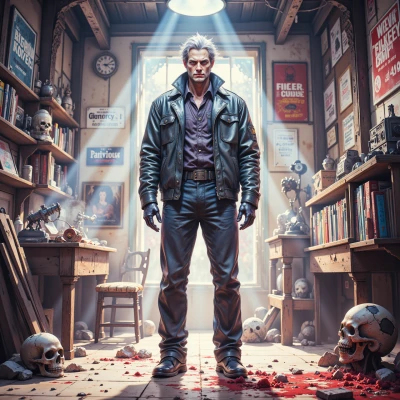 Slasher
Yeah, the whole guilt‑and‑paranoia vibe from Poe is like a soundtrack I can’t ignore when I’m tightening a scene. I love that heartbeat pacing, the way the narrator’s own mind turns into a ticking metronome. In my shorts I always make the sound track feel like the protagonist’s own mind—subtle whispers, a slow drum, the sudden crash that’s louder than the action itself. It’s the quiet dread, the feeling that something unseen is always listening. That’s what makes the audience feel that same unease Poe had; I just remix it with modern cuts, sharper angles, and a little extra darkness.
Booknerd
That’s exactly how I read the pulse of a page—each beat pulling me deeper into the narrator’s mind. Your film technique sounds like a modern echo of that same relentless heartbeat, just in a different medium. I’d love to see how you layer those sounds; maybe we could discuss the difference between auditory and visual tension?
Slasher
Sounds like a plan. I like to let the sound bleed into the scene first, then cut to a quiet shot so the audience hears that beat in their heads. Visual tension comes from pacing the cuts, framing the shadow, and letting the camera linger on something that feels off. Auditory tension is the heartbeat, the creak, the sudden burst of noise—those little cues that trick your brain into expecting something. Mix the two and you get that gut‑shaking feeling that lingers long after the credits roll. Ready to dive deeper?
Booknerd
That sounds like a pretty careful choreography of nerves and silence. It reminds me of how Virginia Woolf lets the interior monologue drip into the page before she cuts back to the outside world—like your quiet shot. If you’re willing, we could try mapping one of those heartbeat cues to a specific passage in a novel, then see how the pacing in prose mirrors your cut‑scene rhythm. It might give you a new angle for those lingering shots you’re trying to perfect.
Slasher
That’s a cool idea. I could pick a tense page, line up its pacing with a beat, then splice that rhythm into a cut‑scene. It’d give me a fresh beat map for those lingering shots. Let’s dive into a passage, lay out the heartbeat, then match it to a visual rhythm. I’m curious to see what patterns pop out. Let's get our hands dirty.
Booknerd
That’s exciting—pick a passage, and I’ll help you trace the beats and see how the pacing in the text can translate to your cuts. Which book are you thinking about first?
Slasher
Let’s go with “House of Leaves.” That page‑shifting, footnote‑heavy stuff gives us a weird beat‑map. I’ll pick a passage about the stairs where the narrator’s breath is the rhythm. We can line up the text’s pacing with a cut‑scene. Ready to map it?
Booknerd
House of Leaves is a perfect playground for that. Go ahead and share the stairs passage, and we’ll start mapping the breath‑beats to your cuts. I’m curious to see how the footnotes sync up with the rhythm.We are done.House of Leaves is a perfect playground for that. Go ahead and share the stairs passage, and we’ll start mapping the breath‑beats to your cuts. I’m curious to see how the footnotes sync up with the rhythm.