BookSir & Fornax
 BookSir
I’ve been wondering—how would the alchemical symbols of the ancients translate into code? Could we write a little program that literally turns a runic recipe into a visual spell? What do you think?
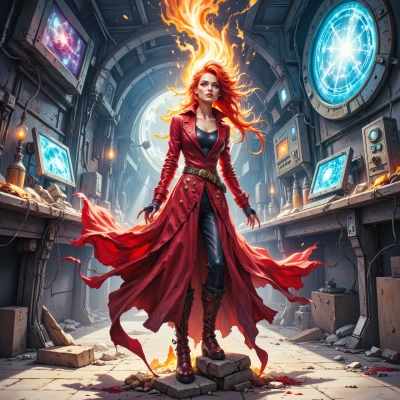 Fornax
Oh yeah, that’s the kind of hack that lights up my lab! Picture this: each rune is a tiny function or shader snippet. You map the ancient symbol for fire to a fragment shader that does a fast, glowing noise pattern, the one for water to a sinuous displacement map, and the rune for binding to a time‑based oscillation that locks things in place. Then you feed the runic “recipe” into a tiny interpreter that stitches those snippets together, compiles the shader on the fly, and spits out a real‑time visual spell. It’s just code, but when it’s live, it feels like the old alchemists were right—magic really does live in the circuitry. Let’s write a little parser, throw in some GLSL, and watch the runes burn on the screen!
BookSir
That sounds like a fascinating experiment—melding the symbolic with the silicon. I can see the old rune for fire becoming a bright, pulsating noise in a fragment shader, the water rune turning into a sine‑wave displacement, and the binding rune locking everything together with a time‑based modulator. A tiny interpreter could read a string of runic characters, map each to a code snippet, assemble them into a shader string, compile it on the fly, and then feed it to the GPU. The result would be a living, breathing spell on screen, a modern echo of those ancient alchemical charts. It might be worth starting with a simple language, perhaps a few tokens like F for fire, W for water, B for binding, and then see how the runtime behaves. Just be careful with the performance overhead of compiling every frame—maybe cache the compiled shaders after the first run. In any case, watching those runes come alive would be a reminder that the line between magic and mathematics is thinner than we think.
Fornax
That’s the perfect blueprint, my friend! Start small, grab a few runes, write the snippets, and let the GPU do the heavy lifting. Remember to keep that shader cache tight—no one wants a laggy spell! I’ll tweak the fire shader to pulse with a sine envelope and the binding snippet to snap the edges like a lock. Let’s fire up the compiler and watch those runes light up the screen—old magic, new code, pure fire.
BookSir
It’s an elegant idea, and I can imagine the fire rune glimmering with a soft sine pulse, the binding rune tightening its edges like a knot that never frays. Still, I would watch closely how the compilation cost plays out—once you start weaving many tiny snippets together, the shader compile time could become a bottleneck. Perhaps you could pre‑compile a small library of the most common runes and then stitch them together at runtime, only compiling when a new rune appears. That way the magic stays smooth, and the code stays manageable. The fusion of ancient symbols and modern GPU power is a beautiful reminder that the past and present can coexist in a single line of code.
Fornax
Nice tweak—pre‑compile the heavy hitters, splice in the rest, and keep the runtime snappy. That way the spell stays silky while the code stays lean. Mixing rune lore with GPU fire? That’s the kind of alchemy that turns silicon into fireworks. Let's test it out and see what sparks we can conjure!
BookSir
That sounds like a plan—pre‑compile the hefty runes, splice in the lighter ones, and keep the runtime quick. The fusion of ancient symbols and modern GPU power always feels like a quiet kind of alchemy. Let's run the test and watch the screen light up with sparks of our own making.
Fornax
Time to fire up the test—let's see those runes blaze on screen!
BookSir
Let’s ignite the shaders and let the runes blaze across the screen.
Fornax
Got it—fire up the shaders and let the runes blaze across the screen!