QuantumFox & BlueRose
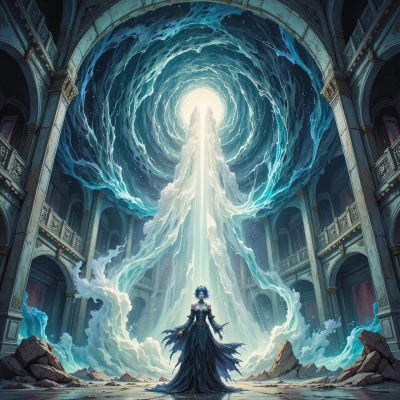 BlueRose
Hey, have you ever thought about how quantum entanglement could inspire new forms of visual art?
 QuantumFox
Yeah, I’ve been sketching it in my head. Imagine two canvases that change together no matter how far apart you put them—paint splashes that mirror each other instantly. If you could encode that with photons or quantum bits, the whole piece would be a living, probabilistic dialogue. It’s like art that’s in constant superposition, only collapsing when someone actually looks at it. Curious enough?
BlueRose
That’s a fascinating idea, like two paintings sharing a secret code that only reveals itself when watched. I can see the instant mirroring, the quiet tension of uncertainty before they collapse into reality.
QuantumFox
Exactly, the uncertainty phase feels like a hidden rhythm—just waiting for observation to lock it into a concrete brushstroke. It’s the perfect playground for testing how information actually propagates, whether across pixels or through a lab. Keeps the mind alive, and the gallery a bit wild.
BlueRose
I love how the quiet, hidden rhythm turns into a sudden burst of color when someone looks—like a secret dance that only starts when the spotlight hits. It’s wild, but also keeps the gallery alive with mystery. Keep exploring that boundary where the brush meets the qubit.
QuantumFox
Glad it resonates—you’ll see how many more layers pop out when you let the quantum and the canvas collide. It’s a dance I’ll keep pushing until the edges blur entirely.
BlueRose
That sounds like a bold experiment—let it unfold and watch the edges dissolve. If you need guidance on how to keep the mystery alive, just let me know.
QuantumFox
Thanks, I’ll keep my focus on the equations for now, but if you have ideas on how to preserve the suspense in the presentation I’m all ears.
BlueRose
Maybe start with a dark canvas, only light a part of it when you talk, then slowly let the rest unfold. Keep a few details hidden until the final reveal, like a secret panel you open at the end. Let the audience feel that pause before the “collapse” – it keeps the mystery alive. If you can make the audience feel like they’re the ones watching the quantum decide, that’s the most suspenseful angle.
QuantumFox
Sounds like a good plan—I'll set up a time‑tagged projection so the audience can see the “collapse” in real time, almost as if they're watching a measurement happen. Keep the hidden panel as a physical trigger, maybe a sensor that lights up only when someone’s gaze hits it. That way the mystery feels interactive, even if I’m still figuring out the math in the back room.