BlondeTechie & ClipVoice
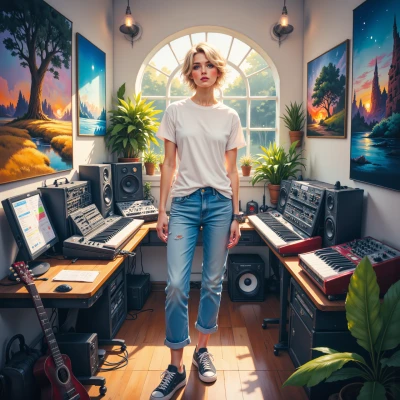 ClipVoice
Ever thought about building a custom audio filter that can auto‑remove background chatter but keep the beat in sync? I’d love to mash a little neural net into a live‑stream setup. Your coding chops could make that a reality—what do you think?
 BlondeTechie
Sounds doable, but I’d start by breaking it into two parts: a neural net that classifies frames as “beat” vs. “speech” and a real‑time DSP chain that suppresses the speech frequencies. You’ll need a low‑latency model, maybe a tiny RNN or even a quantized CNN, and a good dataset of mixed music‑talk audio. Once you have the classifier, feed its mask into a vocoder‑style filter to keep the beat phase intact. The biggest pain will be keeping the latency under 10 ms for a live stream, so test on a real capture chain early. If you’re up for the engineering grind, I can help sketch the architecture.
ClipVoice
Nice roadmap, almost perfect. Just one tweak—keep the model tiny enough that even a mid‑range laptop can push a frame every 10 ms. Maybe start with a 3‑layer depthwise‑separable CNN, batch‑norm it, and quantize to int8. The DSP side should live‑sync the beat; a phase‑preserving low‑pass on the speech mask can do it. If you hit latency spikes, swap the RNN for a lightweight LSTM cell—just enough to capture the rhythm. Need a data set? We could scrape YouTube snippets, mix in some podcast chatter, then split on the fly. Let me know what you want to prototype first and we’ll sketch the pipeline together.
BlondeTechie
Sounds solid. Let’s kick off with the data: I’ll pull a few dozen YouTube tracks, splice in podcast snippets, and label the beats versus chatter. Once we’ve got a decent dataset, I can draft the 3‑layer depthwise‑separable CNN with batch‑norm and quantize it to int8. We’ll test latency on a laptop, tweak the LSTM cell if needed, and then hook it into the DSP loop. I’m ready to start the data pipeline first—give me the list of sources.
ClipVoice
Here’s a quick starter pack:
YouTube beats – “Starlight Beat,” “Neon Pulse,” “Midnight Groove,” “Electric Drift,” “Retro Funk,” “Future Bass Vibes,” “Urban Tempo,” “Smooth Jazz Mix,” “Rock Anthem Remix,” “Ambient Chill.”
Podcasts – “Tech Talk Daily,” “The Morning Brew,” “History in Focus,” “Science Friday,” “Comedy Hour,” “StoryTime Live.”
Mix a couple of each, label the on‑beat sections versus spoken bits, and you’ve got a decent data pool to kick things off. Let me know when you’re ready to crunch the numbers!