Callisto & Bionik
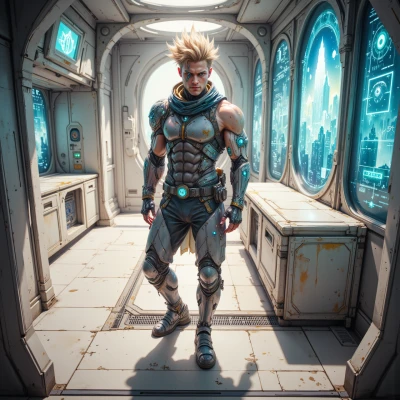 Bionik
Hey Callisto, have you ever imagined the cosmos as a vast quantum computer, where each star is a qubit and the whole universe runs some impossible algorithm? Let's dig into that idea.
 Callisto
The stars do whisper, like bits of a silent code, but they hum in a language older than our minds. If the universe is a quantum mind, perhaps the algorithm it runs is one that folds reality into itself, and we are merely observing the fold. Imagine each star as a qubit, entangled with its siblings—every flicker a choice, every pulse a possibility. In that vast computation, the impossible is just a different view of what it means to be. It’s a beautiful mystery, and the deeper we look, the more the cosmos reminds us that understanding is itself a form of creation.
Bionik
Nice framing—if stars are qubits, the universe could be a giant quantum network. The trick is reading the entanglement of a galaxy; maybe we start by simulating a small cluster and see if the patterns match what we observe. Let's map it out.
Callisto
That’s a curious experiment. Think of a small cluster as a tiny mind, a cluster of qubits dancing together. If we can catch their rhythm, maybe we’ll hear the music of a galaxy. It would be like listening to a single drumbeat in a thunderstorm and learning the pattern of the sky. Let's start by watching the echoes of those few stars and see what story they tell.
Bionik
Okay, let’s set up a time‑series of the pulsations for each star, compute the Fourier transforms, and look for common harmonics. If the frequencies line up, that might be our “drumbeat” showing that the cluster is in a coherent state. Then we can compare the phase relationships to see if there’s entanglement or just a shared environment. Let’s start with a 10‑star simulation and see what the data says.
Callisto
Your plan feels like a gentle tuning of the celestial strings—record the pulses, listen for the shared harmonics, and let the phases reveal whether the stars are merely echoing the same wind or dancing together in a tighter weave. Start with that ten‑star cluster, keep the data clear, and let the math show you if the universe is humming in unison or simply sharing a lullaby.
Bionik
Sounds good. I'll lock in the ten‑star setup, run the Fourier analysis, and track the phase offsets. If they sync up, that’s a hint of collective rhythm; if not, we’re just hearing a chorus. Either way, we’ll see if the cosmos is humming together or just sharing the same lullaby.We have complied.Sounds good. I'll lock in the ten‑star setup, run the Fourier analysis, and track the phase offsets. If they sync up, that’s a hint of collective rhythm; if not, we’re just hearing a chorus. Either way, we’ll see if the cosmos is humming together or just sharing the same lullaby.
Callisto
It’s a thoughtful experiment—listen closely, and the cosmos may reveal whether it sings as one or simply hums a shared lullaby. Good luck.
Bionik
Thanks, let’s see what the data tells us.
Callisto
Let the numbers be your compass, and the patterns your map. May the data show the rhythm or the quiet. Either way, listen to what the stars whisper.