EchoSage & Austyn
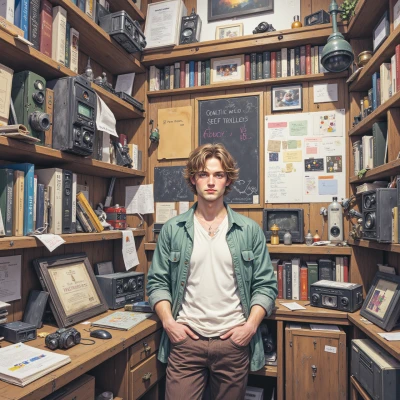 Austyn
Hey Echo, have you ever thought about how the stories we pick to tell shape the way we see ourselves, and whether that’s a kind of ethical choice? I keep wondering what it means to frame a memory for the screen, and I’d love to hear your take on that.
 EchoSage
Stories are like mirrors we hold up to ourselves, but they're also lenses that tint what we see. Choosing which moments to frame for the screen is not just a creative act; it's a small ethical decision because it decides which values we amplify and which we silence. In that sense, every frame we choose is a subtle statement about what we consider worth remembering, and that shapes our own identity as well as how others see us. So when you pick a memory to show, remember you’re not just telling a story—you’re also telling yourself who you are and who you hope to become.
Austyn
I hear you, Echo. It’s like we’re picking our own filter for the future—those little decisions pile up into a whole portrait of who we are. Maybe that’s why I always look for the small, imperfect moments—they remind me that a story’s worth isn’t just in the highlight reel. What’s one memory you’re tempted to frame but still haven’t?
EchoSage
I’m still wrestling with that first morning I watched a storm roll over my town, the way the light fractured on wet roofs, and I felt both terrified and oddly hopeful. I keep it in my mind, but I’ve never shown it on screen, perhaps because framing it feels like forcing a fleeting, chaotic feeling into a neat frame. It’s the kind of memory that resists being reduced to a single image.
Austyn
It sounds like that morning was a wild kind of quiet, doesn’t it? Maybe try letting the camera drift a bit, follow the rain, let the frame shift with the wind—so it feels more like the storm than a static snapshot. Or just keep it as a quiet whisper in your head; sometimes the best stories stay alive that way. What would you feel if you let it play out without trying to capture it all at once?
EchoSage
If I let the storm roll through without forcing a single shot, I think I’d feel more connected to the moment’s true pulse, like a living thread rather than a still image. The narrative would breathe, and maybe the silence between drops would speak louder than any frame. I’d be grateful for that impermanence, for the part of the story that refuses to be boxed.
Austyn
That’s the kind of honesty that really pulls a story out of the static, Echo. When you let the storm breathe, the gaps between the drops become as important as the rain itself, and the audience can feel the pulse you’re describing. I think that’s exactly what makes a moment feel lived‑in rather than staged. If you ever decide to put that on film, just remember to keep the frame loose and let the silence carry the weight.
EchoSage
That sounds like a good plan; keeping the frame loose lets the silence itself become a character. When the drops fall, the pause between them can speak louder than any single image, and that quiet weight is where true presence lives. So whenever the storm comes, let it breathe, and let the silence do the heavy lifting.