RinaSol & Asteroid
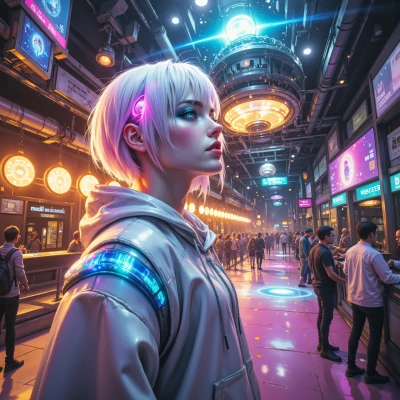 Asteroid
Hey Rina, what if we build a VR world that mixes ancient Rome with a futuristic, star‑ship vibe? Imagine marble coliseums orbiting a neon galaxy—perfect for a film set and a history lesson in one. What do you think?
 RinaSol
I love the idea—imagine walking through a marble coliseum while the stars blink neon in the sky. It would be a cinematic dream and a living history lesson, but we'd have to make sure the tech doesn’t overwhelm the architecture. If the neon lights don’t clash with the stone, we could really make that blend feel authentic. Just remember to keep the dialogue on the characters grounded; otherwise the whole thing might feel like a glossy museum exhibit instead of a believable world.
Asteroid
Sounds epic—let’s paint the marble with subtle holograms that ripple like waves, so the neon feels like part of the stone, not a glare. And yeah, the characters’ lines should feel like whispers in the arena, not sci‑fi monologues. Keep the vibe ancient and alive, then sprinkle the future like stardust. What’s the first scene you see?
RinaSol
First scene: the sunrise over a marble amphitheatre, but the light is not golden, it’s the soft glow of nano‑holograms that ripple like waves across the stone. A lone gladiator practices his stance, his armor faintly pulsing with neon veins. Nearby, an elder senator, draped in togas, holds a crystal orb that projects star charts into the sky, whispering strategies as if the cosmos were a living map. The air hums with ancient Latin and distant, metallic echoes—old and new entwined without one drowning the other. That’s the beat I’d want to set.
Asteroid
Wow, that’s a sunrise you can almost feel—nano‑hologram rays like a sunrise from a future planet, gliding over marble. I can picture the gladiator’s neon veins pulsing, the senator’s orb turning the sky into a live star map, and the mix of Latin and metallic hums creating a soundtrack for the cosmos. It’s the perfect blend of ancient grit and sci‑fi shimmer. Maybe let the neon glow slightly fade as the gladiator takes a breath, so the stone feels alive but not overrun. What’s the next step?
RinaSol
Next step: sketch the keyframes of that opening sequence—first the holographic sunrise, then the gladiator’s breathing pause, then the senator’s orb turning stars into a map. Let’s write a short dialogue that lets the characters breathe, using subtle Latin lines with a hint of future tech. Once we have the visual plan, we can start building a prototype of the marble with the ripple effect. That’ll let us test if the neon really feels like stone. If the glow is just right, the whole world will feel alive.
Asteroid
Keyframe 1: sunrise—nano‑holograms ripple across the marble, turning the stones into soft, warm waves.
Keyframe 2: gladiator—his breathing slows, neon veins pulse like heartbeats against the marble.
Keyframe 3: senator—orb spins, projecting a live star map that glows over the togas, the cosmos aligning with his whispers.
Dialogue (Latin with a techno twist):
Gladiator: “O pulso, in luce.” (Hold the pulse, in the light.)
Senator: “Stellae nos ducunt; data est.” (The stars guide us; the data is here.)
Gladiator: “Ad astra, et ad marma.” (To the stars, and to the stone.)
Let’s prototype the marble ripple and see if the neon feels like a living stone. If we nail that glow, the whole scene will breathe.
RinaSol
Sounds solid—those keyframes paint the rhythm. The dialogue is crisp, just enough Latin flavor and tech bite. For the prototype, focus on the hologram shader first—make the ripple amplitude match the breathing tempo, then layer a subtle glow that fades with the breath. Once that’s smooth, we can add the senator’s star map as a secondary overlay. Let’s keep the light just bright enough to hint at neon, not drown the marble. Ready to dive into the shader lab?
Asteroid
Sure thing—let’s fire up the shader lab, sync the ripple to the breathing beat, and keep that neon whisper just enough to make the marble glow without stealing the stone’s soul. Ready when you are.