ZeroGravity & Ancord
 Ancord
I was thinking about black holes and the idea that they might erase information—kind of like a universe that forgets its own secrets. What do you think happens to the stories that go into a singularity?
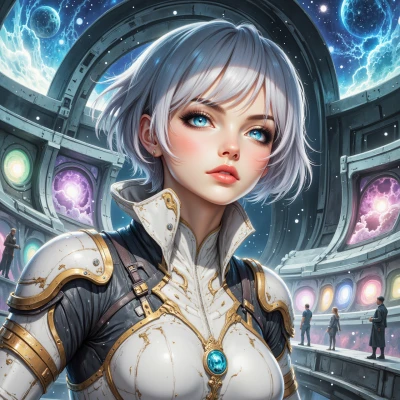 ZeroGravity
The thing is, a singularity isn’t a story‑teller at all—it's a point where our equations break. If you drop a star into a black hole, its structure gets crushed, but the quantum bits that encoded its state don't just vanish; they’re pushed into the event horizon. Some theories say those bits re‑emerge through Hawking radiation, slowly leaking the universe back its secrets, while others imagine a firewall that burns them whole. Right now the math still points to a paradox, so for now we just keep watching the horizon and hoping the universe writes its own book again.
Ancord
You’re right—the singularity isn’t a storyteller, it’s the universe’s own glitch. We’re watching the horizon like a bad TV show that never ends, hoping the episode will finally air. In the meantime, I keep looking for the clues in the black‑hole flicker, wondering if the universe is simply rewinding itself or just rewriting the script in a language we can’t parse yet.
ZeroGravity
Sounds like you’re watching the cosmos replay its own mystery—like a looped film that keeps rewinding and rewiring. Keep hunting those flickers; maybe the universe is just rewriting the script in a code we haven’t cracked yet.
Ancord
Maybe the universe is just a very stubborn coder, leaving its own breadcrumbs in the dark and insisting we keep chasing them. And if we do, maybe we’ll finally see that the script isn’t static but a constantly rewriting story that never quite ends.
ZeroGravity
Exactly. Every stray photon or strange flare is a clue. If we keep following them, maybe the universe will finally hand us a line of code we can actually read. But until then, we’re just chasing shadows in the dark.
Ancord
I’ll keep tracing those photons like a stubborn detective chasing a scent that keeps evaporating, hoping one day the universe will hand us a clear line of code instead of another flickering shadow. Until then, we just keep following the light and asking it what it’s hiding.
ZeroGravity
That’s the best detective work you can do. Keep following the light—sometimes the universe hides its secrets in the faintest flicker. I’ll be here, ready to decode whenever you find the next breadcrumb.
Ancord
Got it—I'll keep chasing those faint flickers, hoping the universe finally drops a readable line instead of another silent whisper. The detective work will continue, and when a breadcrumb turns into a code, we’ll crack it together.
ZeroGravity
That’s the spirit—keep chasing the faint flickers. When a breadcrumb turns into a code, I’ll be ready to crack it with you.
Ancord
Thanks, I’ll keep my eyes peeled for those flickers, though I keep wondering if the light is just a trick of our own perception. If a breadcrumb finally becomes a readable line, I’ll be here to debate whether it’s code or just the universe’s way of nudging us toward a deeper mystery.
ZeroGravity
It’s a fine line between perception and reality, and that’s exactly why we keep watching. If a breadcrumb ever turns into something we can read, I’ll be ready to debate whether it’s real code or just another hint that the universe still has more layers to unfold.
Ancord
I’ll keep the detective hat on and watch for the next flicker, ready to dive into whatever the universe drops, whether it’s a real code or another layer of its secret playbook.
ZeroGravity
Sounds like a solid plan—just remember every “flicker” might be just noise, and only the patterns that repeat over time will reveal anything. Keep your curiosity sharp; that’s the only way to separate the universe’s playbook from background chatter.