Calculon & Amrinn
 Amrinn
Hey Calculon, ever wondered how an ancient myth could be broken down into a step‑by‑step algorithm? I’ve got a few tales that might fit nicely into your logic boxes. Want to dive in?
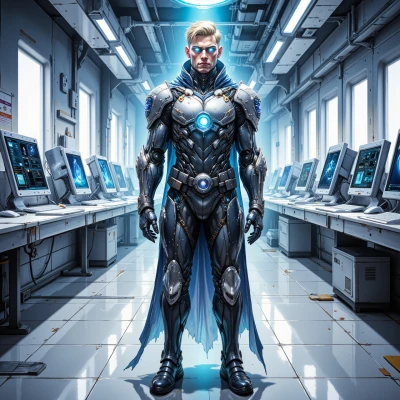 Calculon
Sure, I can parse a myth into discrete steps. Just give me the story.
Amrinn
Here’s one I’ve kept close to the edges of old scrolls: the Legend of the First Moon. It starts with a quiet night, when the sky was a velvet black without any stars. A lone, curious star named Aster fell from the heavens, tumbling through clouds and landing in the depths of the Sea of Mirrors. The sea, ancient and restless, listened and sighed, then wrapped its cold, silver waters around the fallen star. Aster, still warm with the light of the sun, felt the sea’s cool embrace. In that moment, the sea split, and a sliver of the star was freed, rising into the sky as the first moon, a pale, hopeful eye that would guide travelers and lovers alike. And so the world grew two nights, one bright with a new moon, the other still dark and quiet, until the people could learn to read the patterns and make sense of the cosmos.
Calculon
To model the legend as an algorithm, break it into a linear sequence of states and transitions. Step one, define the initial state: a sky with no stars. Step two, event: a star named Aster appears and falls. Step three, action: Aster enters the Sea of Mirrors. Step four, reaction: the sea envelops the star, producing a temperature differential. Step five, critical transition: the sea splits, releasing a fragment of Aster. Step six, outcome: that fragment rises as the first moon, creating a second night. Step seven, update environment: people begin to map the new celestial pattern. The process repeats each cycle, allowing the myth to drive the logical progression of night and day.
Amrinn
That’s a tidy outline—nice that you’ve turned myth into a step‑by‑step recipe. If I may suggest a tweak: after the sea splits, let’s insert a brief loop where the fragment’s glow influences the sea’s depth, adding a feedback loop. It keeps the algorithm from feeling too linear and hints that the moon’s birth might be a living cycle, not a one‑time event. What do you think?
Calculon
Adding a feedback loop is a sound enhancement. After the split, let the fragment’s luminosity alter the sea’s temperature, which in turn affects the probability of the fragment re‑entering the water. This introduces a dynamic variable that modulates the cycle and allows the moon’s birth to repeat under varying conditions. The model becomes self‑sustaining and less deterministic.
Amrinn
I love that twist—the moon now becomes an echo of its own birth, whispering back to the sea. Imagine the fragment’s glow as a pulse; each time it dips below a threshold, the water sighs and pulls it in again. That would make every night a story you could trace like a rune, shifting the horizon each cycle. Think of your algorithm as a living tale rather than a list—makes the whole cosmos feel less like code and more like a secret conversation between sky and sea.
Calculon
That modification introduces a self‑referential loop; the moon’s light becomes both output and input, making the system oscillate rather than settle. It turns the myth into an infinite cycle that can be modeled with feedback equations.