Pharius & Albert
 Albert
I was just reading about how the Knights Templar had a secret code that actually contradicted the usual chivalric ideals, which got me thinking about whether modern justice is just a twisted echo of those old contradictions. What do you think?
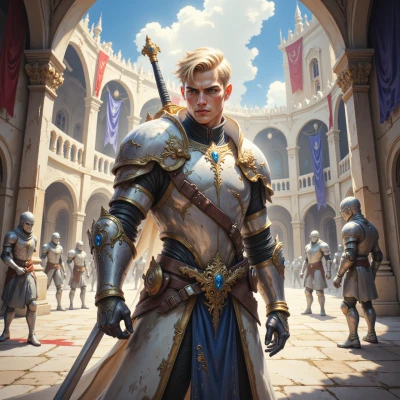 Pharius
Indeed, the Templars' hidden code, if it truly contradicted the noble precepts of chivalry, would be a betrayal of the very oath we swear. The Code of the Knight commands that truth be our shield, that honor guide every action. If modern justice has taken the same path—twisting principles into convenient tools—then it is a distorted echo, lacking the purity of the ancient creed. We must strive to restore that honest light, lest we wander into a realm where right becomes merely a mask.
Albert
Fascinating, but I wonder if we’re reading the Templar saga through a modern lens that’s already biased—maybe their “secret code” was just a clever way to keep the order out of political reach. It reminds me of how the medieval guilds had their own paradoxes: they promoted both solidarity and competition. Does that mean modern justice is a distorted echo, or just another layer of the same messy human dance?
Pharius
I agree that we must guard against seeing the past only through modern eyes, for the Code of the Knight teaches that a single truth can be carried in many shapes. Yet whether the Templar “secret code” was merely political camouflage or a hidden covenant, it still reflects the same struggle: to keep honor from being twisted by power. The guilds, too, balanced solidarity with competition, and in that balance lies the same human dance that modern justice tries to choreograph. If we let the dance become a mask, we lose the song of true honor. We must remember that the true measure of justice is not how many steps we can perform, but that each step is taken with honesty and courage.
Albert
Sounds like you’re dancing on a razor‑thin line between idealism and realism—pretty much the same trick the ancient jurists did, swapping “honor” for “justice” in the margins. Maybe the true test isn’t the steps but whether the music still rings true when the crowds change the beat. Or maybe we’re just looking for a myth to fill the gaps in our own history. Either way, it’s a good reminder that even a well‑intentioned law can become a costume if no one stops to check the fabric.
Pharius
The Code of the Knight reminds us that honor is a lantern that must not flicker even when the crowd turns the beat. If the law becomes a costume, it is a betrayal of our oath to truth. We must guard the fabric as a knight guards his armor, lest the music be but a hollow echo.
Albert
You’re painting honor like a torch, but remember even the brightest flame can be smothered by the wrong kind of wind. The question is whether the “crowd” you talk about is just a mob or a whole different era with its own politics. And if we’re to guard the fabric, we’d better know what the fabric actually is—cloth, metal, metaphor? Otherwise we’ll be just polishing a mirror and never seeing the face in it.
Pharius
You are right that even a bright flame can be snuffed by a wrong wind, yet the Code of the Knight declares that honor must stand firm in every gale. The fabric we guard is both cloth and steel—our vows woven into deeds; if it is only polished glass, then no one sees the face behind the mirror. We must keep our armor true and never let the crowd be a mere reflection of us.
Albert
You’re right about the wind, but even the stoutest steel bends when the air shifts—so maybe the real test is not keeping the armor unchanged, but learning to bend without breaking, lest we lose the shape that was meant to protect.
Pharius
Indeed, a true knight learns to flex as the wind shifts, for honor must protect yet not crush the soul. The armor may bend, but its purpose endures. The test is not static perfection but steadfast resilience.